
Types of Upper & Lower Extremity Braces and Their Benefits
Supporting Movement, Stability, and Recovery
Pain, weakness, injury, or joint instability can make everyday movement difficult. Upper and lower extremity braces can provide the support needed to improve stability, protect vulnerable areas, and make movement more comfortable.
From arm braces and wrist supports to knee braces and ankle-foot orthoses, orthopedic bracing can be customized to address different conditions and mobility needs. Understanding the types of upper and lower extremity braces can help patients and caregivers recognize which solutions may be appropriate.
What Are Orthopedic Braces?
Orthopedic braces are supportive devices designed to protect, stabilize, align, or assist a specific part of the body. They may be recommended following an injury, during rehabilitation, or for conditions that affect normal movement.
Custom orthopedic braces are made to fit an individual’s anatomy and functional requirements. Compared with generic supports, custom solutions can provide more targeted positioning and support.
So, when are orthopedic braces needed? They may be considered when additional stability or support is needed for an injured, weakened, misaligned, or developing joint or limb.
Types of Upper Extremity Braces
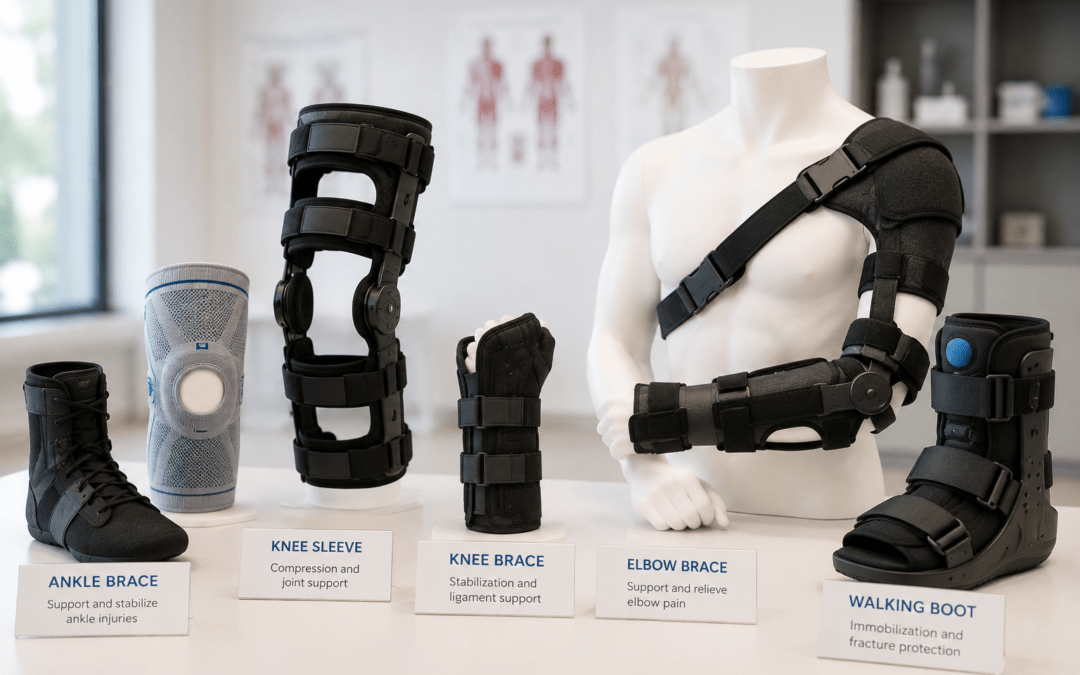
Upper extremity braces support areas such as the shoulder, arm, elbow, wrist, and hand. Common options include:
| Brace Type | Common Purpose |
| Arm braces | Support the arm following injury or during recovery |
| Elbow braces | Provide stability and help manage elbow movement |
| Wrist and hand braces | Support the wrist, hand, and fingers |
| Shoulder supports | Help stabilize and protect the shoulder |
The benefits of upper extremity braces can include improved positioning, reduced strain, protection during recovery, and greater confidence when performing everyday activities.
For patients who need more specialized support, custom braces for arm and leg support can be designed around their anatomy and functional goals.
Types of Lower Extremity Braces
Lower extremity braces are commonly used to support the hip, knee, ankle, and foot. Some of the most familiar options include:
- Knee braces: Help stabilize and support the knee during activity or recovery.
- Ankle braces: Provide support for an unstable or recovering ankle.
- Ankle foot orthosis: An AFO supports the ankle and foot and may help improve positioning and walking mechanics.
- AFO braces: These can be customized to provide different levels of support based on a patient’s needs.
- Leg braces: May provide broader support for the lower limb depending on the condition.
These forms of extremity orthotics can be particularly useful when weakness, instability, or abnormal movement affects walking and daily activities.
Custom Orthotic Braces vs. Standard Braces
Not everyone needs a custom device. Standard braces can be useful for certain situations, but custom orthotic braces provide individualized support based on the person’s body structure and functional requirements.
One of the major advantages of custom solutions is that how custom braces improve mobility depends on how accurately the brace addresses the individual’s specific movement needs. A properly designed brace may help improve alignment, stability, and control while allowing appropriate movement.
Key Benefits of Upper and Lower Extremity Bracing
The specific advantages depend on the type of brace and the patient’s condition, but orthopedic bracing may provide several important benefits:
1. Improved Stability
Braces can help stabilize joints and body segments during movement. This can be particularly valuable for individuals who experience weakness or instability.
2. Injury Protection
Orthopedic braces for injury recovery can help protect affected areas while the body heals. A brace may limit unwanted movement while still allowing appropriate activity based on professional recommendations.
3. Better Mobility
Braces for improving stability and mobility can make certain movements easier and more controlled. For some patients, improved support can make walking, reaching, standing, or other daily activities more manageable.
4. Personalized Support
Custom orthopedic braces can be designed around individual anatomy, activity levels, and treatment goals. This can provide a more precise solution than a one-size-fits-all device.
Choosing the Right Brace: A Step-by-Step Approach
Finding the appropriate brace starts with understanding the problem and the patient’s goals.
Step 1: Identify the area requiring support. Determine whether the issue involves the arm, elbow, wrist, hand, leg, knee, ankle, or foot.
Step 2: Consider the purpose. A brace may be needed for injury recovery, stability, alignment, mobility assistance, or protection during activity.
Step 3: Get a professional evaluation. A qualified orthotist can assess movement, strength, alignment, and functional needs before recommending a device.
Step 4: Determine whether customization is appropriate. If a standard brace cannot provide the necessary positioning or support, a custom device may be recommended.
Step 5: Follow fitting and care instructions. Proper fitting and regular follow-up help ensure that the brace continues to provide effective support as the patient’s needs change.
Conclusion: Better Support for Better Movement
The many types of orthopedic braces available today make it possible to address a wide range of mobility and support needs. From upper extremity braces to lower extremity braces, these devices can help improve stability, protect recovering areas, and support more confident movement.
Whether you are considering arm braces, knee braces, AFO braces, wrist and hand braces, or a custom solution, professional evaluation is an important part of choosing the right device. With the right custom orthotic braces and care plan, patients can receive support designed around their individual needs and goals.